
Tift County Three-Day Releases
Tift County has no distinct official 72-hour release page. The sheriff mobile site publishes a “48 Hour Release” view. OffenderIndex has a last-24-hour bookings tab, but bookings record admission to jail rather than departure. For the third day, use the booking-date search with “Include Previous Inmates In Search,” then confirm the release through the jail or court.
A three-day check is useful after a weekend or holiday because a person may have left custody before the user begins searching. Yet combining screens does not create a formal 72-hour list. Each entry still needs a source record showing whether the person bonded out, finished a sentence, left on a court order, or transferred to another agency.
Build a Tift Release Window
- Review the official 48 Hour Release view for the first part of the period.
- Open OffenderIndex Tift County and use the booking-date search for the full date range.
- Select “Include Previous Inmates In Search” so people who left the live roster can appear.
- Do not count a booking as a release. Match the result with a release event or source record.
- Call the jail at 229-388-6020 for current status and request the release record if formal confirmation is needed.
- Check the correct court for the bond order, sentence, or disposition that explains departure.
The Tift County 24-hour release guide separates same-day booking data from the sheriff's 48-hour release page. Use it when the event is very recent.
Tift County Release Evidence
Because there is no single three-day feed, record the source of each fact. The public interfaces may change and may not expose all formal release fields.
| Evidence | What it means |
|---|---|
| 48 Hour Release entry | A recent departure shown by the sheriff's release-specific mobile view. |
| Prior-inmate result | An earlier Tift booking remains searchable after the person leaves the current roster. |
| Release date and time | The sheriff's record of when county custody ended. |
| Release reason | The reported basis, such as bond, sentence completion, court order, or transfer. |
| Court order | The legal action behind a bond or case-related release. |
| Destination agency | Shows whether departure was a transfer rather than community release. |
Name matching alone is weak proof. Booking identifiers, dates, court numbers, and agency data help separate people with similar names.
Tift Weekend Release Delays
The jail operates continuously, but the public display, court docket, and records response may update on different schedules. A bond payment also precedes physical release. For city arrests, the City of Tifton says the records clerk issues a receipt and an officer takes the release slip to the Law Enforcement Center. Staff still must complete the custody process.
A weekend search should therefore cover booking dates before and after the expected event. If a name is absent from both the live roster and 48-hour view, use the prior-inmate search. Then call the jail. The Tift County named-person release path explains how court and agency records can close the gap.
Tift Bookings Are Not Releases
The OffenderIndex label “Bookings Made in the Last 24 Hours” is easy to misread during a Tift County release search. It reports recent entry into custody. It does not say that the listed person left jail. Someone can appear in that tab and remain in the Current Inmates view. Another person may post bond later and then move to the sheriff's 48 Hour Release view.
For a sound three-day check, keep those events apart. Booking date and arresting agency identify the local jail episode. Current status says whether the person still appears housed. A release date, release time, reason, or transfer notation explains how that episode ended. If only the booking entry is visible, the research is not finished. Check the current roster and release view, then ask the jail or court for the missing fact.
Does absence from Current Inmates prove release? No. The person may have been released, transferred to GDC, moved to another jail, or taken into federal or immigration custody. Confirm the destination before describing the event.
Request Tift Release Records
The sheriff's open-records instructions allow verbal or written requests under O.C.G.A. 50-18-70. Ask for the booking sheet, release date and time, reason, bond data, and transfer destination. Give the full name, approximate booking date, arresting agency, and case number when known. David Haire is the listed Open Records Officer, and Captain Chad Davis is the alternate. The office may charge fulfillment costs and provides an estimate.
Georgia VINE can send later custody-status alerts for participating agencies. GDC covers state-prison custody, not an ordinary Tift bond release. The BOP locator applies to federal prison records, and ICE's locator applies to immigration custody. These sources are fallbacks only when the custody type fits.
Tift Transfer Records
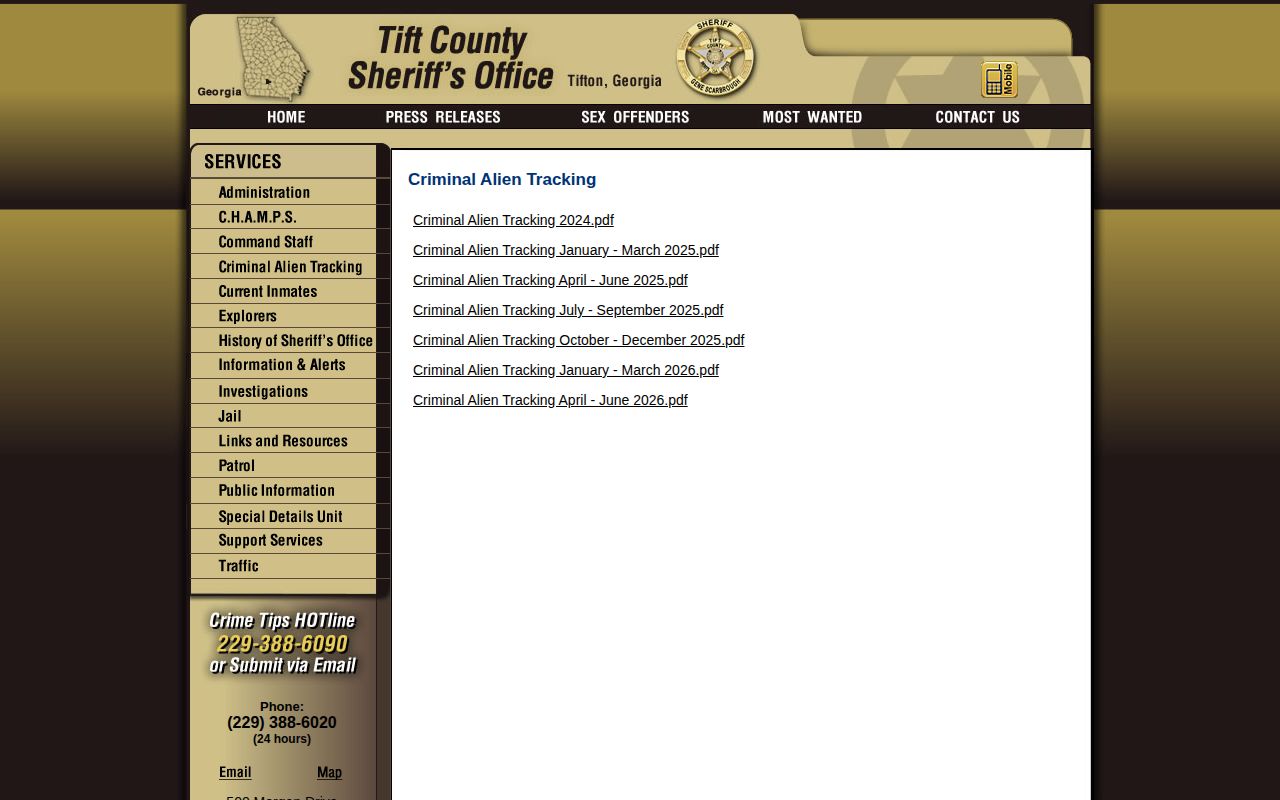
The Tift County Sheriff's Office publishes a Criminal Alien Tracking page with annual and quarterly documents. It does not prove that any named person entered ICE custody. It does show why a local departure may need transfer checks. If an immigration detainer is involved, the person can vanish from the county roster while remaining held elsewhere.
The sheriff tracking-page image provides local context for this transfer path.
Use the latest named agency and the official ICE locator rather than inferring status from the county page.
Why Tift Uses 48 Hours
Tift County's distinctive roster detail is the mismatch between common search language and the official pages that were found. The sheriff's mobile page is expressly called “48 Hour Release.” The roster provider separately offers “Bookings Made in the Last 24 Hours.” Research found no official Tift County page labeled as a 72-hour release list. Those labels describe different data and should remain distinct.
The mobile release page is part of the sheriff's mobile path, reached from the desktop site's mobile entry point. No separate named sheriff phone app was confirmed. A user looking for three days of releases should not search an app store or assume the 24-hour booking tab fills the gap. The reliable method is to review the two-day release view, search the third day's booking range with previous inmates included, and verify any possible departure.
This method can identify likely records without overstating what the public pages prove. It also explains why an empty short-window view does not mean no one left the jail. The page may change with time, and research did not find a published refresh schedule or broader retention promise for the mobile release display.
Confirm the Tift Release Reason
The court trail often supplies the legal reason behind a Tift County Jail departure. Magistrate Court handles bond hearings, warrants, and preliminary-hearing work. State Court covers misdemeanor criminal cases and certain traffic matters. Superior Court handles felony proceedings. City of Tifton Municipal Court is the relevant clerk for city ordinance and traffic cases within its authority.
Ask for the specific record that fits the event: a bond order, disposition, sentence, probation order, dismissal, or warrant status. A release slip can start physical discharge from the jail while the case remains open. A sentence ending can produce a true completion of local custody. A transfer order can end custody at Tift without releasing the person to the community. This is why a three-day name list alone cannot answer the legal-status question.
When requesting jail records, include enough detail to find the correct episode. A full name, booking date range, arresting agency, and known case number reduce confusion. Ask whether the record contains the release date, time, reason, and destination. The sheriff's public information page says requesters are responsible for fulfillment fees and that an estimated preparation cost will be given.
Keep an event log while checking the three-day span. Note when each source was viewed, the exact status label, and the agency named on the record. This helps when a screen changes before the jail or court responds. It also prevents a prior booking from being mistaken for a new release.
For a city cash-bond case, Tifton's process adds one more clue. Cash bonds before 5 p.m. go through Municipal Court, while the police department accepts them after 5 p.m. The records clerk issues a receipt and calls an officer to carry the release slip to the Law Enforcement Center. This can explain a gap between payment and departure, but it does not set a fixed release hour.
The final description should match the proof. Use “no longer shown on the current roster” when that is all the screen establishes. Use “transferred” when a destination is documented. State the release reason only when a jail or court record supports it.