
Tift County Booking Photos
A booking photograph is made by an arresting agency for identification or during jail processing. Release does not erase the underlying arrest record, but it also does not guarantee that a photo remains online. Georgia law restricts when law-enforcement agencies post booking photos and when they provide copies. Juvenile, sealed, restricted, or otherwise protected records may be withheld or redacted.
The image must be read in context. A county booking photo reflects a past intake at the Tift County Jail. A GDC image belongs to the state-prison record. A registry photo appears because a separate registration law applies. None of those images alone establishes present custody or a case outcome.
Tift Released Mugshot Channels
| Channel | Photo? | Access |
|---|---|---|
| Sheriff roster or prior-inmate record | Only if the live public record displays one | Search OffenderIndex and include previous inmates. |
| Sheriff mobile release page | Not confirmed by the research | Check the 48 Hour Release view without assuming an image exists. |
| Open-records request | May be available subject to law | Request it from the sheriff with the required compliance statement. |
| GDC offender search | Photos display automatically when available | Use for state-prison offenders, not ordinary local releases. |
| GBI registry | Yes for covered registrants | Use only when the separate registration law applies. |
| Press and news | Sometimes | Discovery only, not a complete or current custody source. |
| Commercial aggregators | Sometimes | May be stale; no commercial source is endorsed or linked here. |
Tift Mobile Mugshot Limits
The sheriff desktop site links to a mobile web page labeled “48 Hour Release.” No separate named sheriff smartphone app was confirmed, so the mobile page should not be called an app. The research also did not confirm that the mobile release entries display photos. Check the live record, and do not promise an image where the source has not shown one.
OffenderIndex offers current inmates, last-24-hour bookings, and booking-date searches with an option to include prior inmates. The Tift County recent-release guide explains those controls. A booking entry and a release event remain different records.
Request Tift Booking Photos
The sheriff accepts verbal or written open-record requests under O.C.G.A. 50-18-70. Georgia's booking-photo rule, O.C.G.A. 35-1-19, also requires a requester statement about compliant use and restricts disclosure where the image may be posted on a site that charges for removal.
- Identify the person, approximate arrest date, and arresting agency.
- Ask the Tift County Sheriff's Office for the specific booking photograph and related booking identifier.
- Submit the compliance statement required by Georgia law.
- Ask for a cost estimate before processing if cost matters.
- Review any redaction or denial against the stated legal basis.
David Haire is the listed Open Records Officer, with Captain Chad Davis as alternate. The jail line is 229-388-6020. The Tift County release-record guide covers requests for the associated release facts.
Tift Mugshots in Local News
The sheriff press page and WALB may publish a photo with a public-safety story. They are selective news sources, not booking-photo archives. A story can remain visible after release or after the case changes. Use the date and named agency, then confirm custody and disposition from official records.
Commercial mugshot and aggregator sites may also retain old images. They are not linked or endorsed. Their captions, dates, and removal claims may be wrong or stale. Georgia provides a statutory no-charge removal route in qualifying cases.
Georgia Mugshot Removal Rules
Georgia's Attorney General explains that O.C.G.A. 10-1-393.5 requires a commercial site to remove a mugshot at no charge within 30 days when one of eight listed circumstances applies. Examples include restricted records, specified dismissals or nolle prosequi outcomes, two no bills, acquittal of all charges, and certain completed drug sentences. Release alone is not enough.
The written request must include the name, date of birth, arrest date, and arresting agency. It must be sent by certified mail with return receipt or by statutory overnight delivery to the publisher's registered agent, principal place of business, or primary residence. Do not pay a removal demand when the Georgia no-charge path applies.
Georgia Booking Photo Limits
O.C.G.A. 35-1-19 says an arresting agency may not post booking photographs except as the law permits. It also bars supplying a copy when it may appear on a publication or site that requires payment or other value for removal. A requester must affirm compliant use, and a knowingly false statement can carry consequences under Georgia law.
The statute page documents these limits.
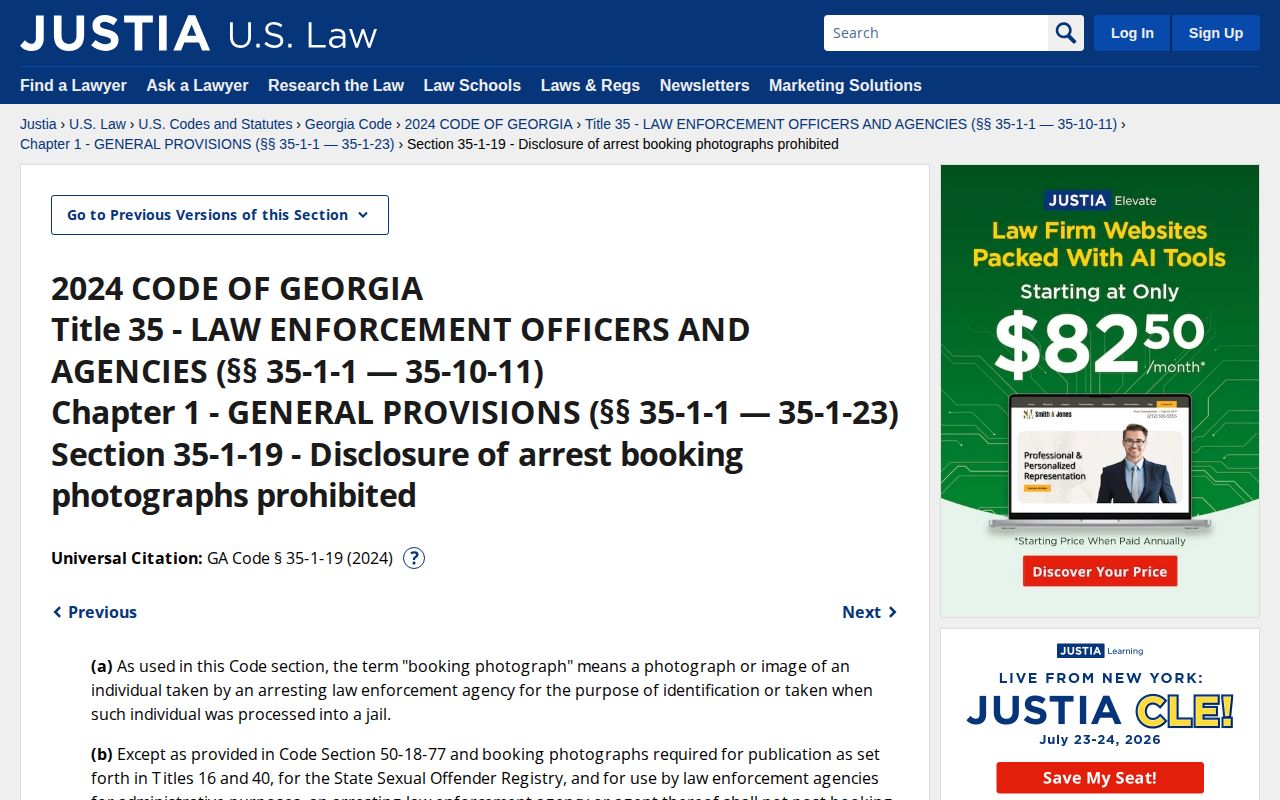
The law explains why online access may be narrower than access to other arrest-record fields.
Tift State Release Photos
A Tift County booking photograph and a Georgia Department of Corrections offender photo come from different custody systems. The sheriff photo is tied to county booking. The GDC Find an Offender page applies when a person entered state-prison custody. GDC warns that offender photos, when available, display automatically with public search results. A released state offender can therefore have a state image even when no county photo remains online.
Search GDC by name, GDC ID, or other supported fields. Compare identity, sentence, facility, and status details rather than relying on the face alone. GDC data does not document an ordinary bond release from the Tift County Jail. Written verification of a state record goes to GDC Inmate Records and Information at P.O. Box 1529, Forsyth, Georgia 31029.
Tift Registry Photo Boundaries
The Georgia Bureau of Investigation registry and the sheriff's OffenderWatch link can display photos for people who have a separate duty to register under Georgia law. That registry is not a list of all released Tift County inmates. It should be checked only when the person and the reason for the search fit the registry's legal scope.
A registry image may be newer than a jail booking photo because registration continues after custody. The record can also show identifying and registration details that do not belong to the original booking sheet. Do not merge the two records. Confirm a jail release through the sheriff, a state-prison discharge through GDC, and a registration record through the GBI system.
The public registry search is shown in the captured source below.
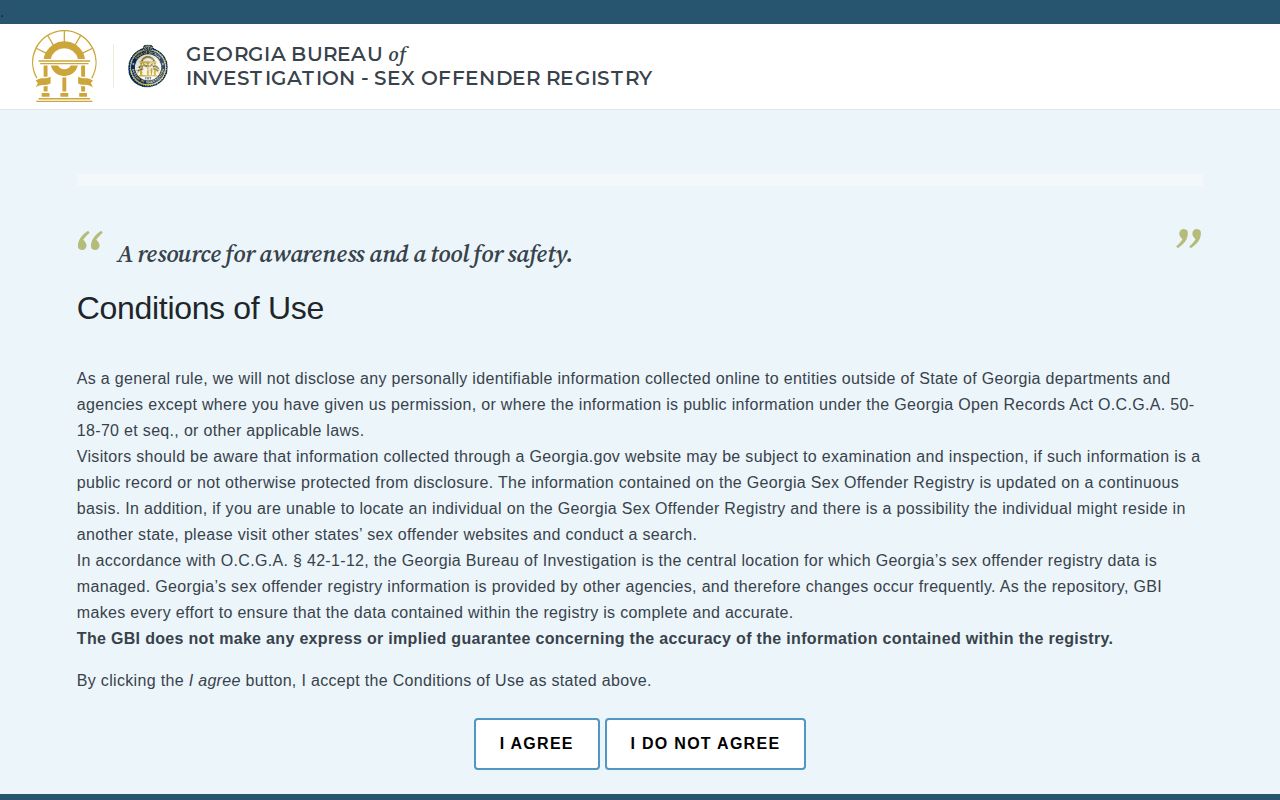
The image demonstrates the separate registry channel and should not be read as a county release gallery.
Match Tift Mugshot Records
Use the full record around a photo. Compare the legal name, known date of birth when lawfully available, booking date, arresting agency, booking number, and case number. A face can change with time, and two people can share a name. The photograph should support an identity check, not replace the text fields.
Then check the record's date and source. A sheriff press release may describe an arrest, while the court file later records dismissal, nolle prosequi, a plea, or acquittal. A commercial copy may omit every later change. For a correction, contact the source that controls the record. The sheriff addresses its booking file, the clerk addresses court entries, GDC addresses state records, and the publisher controls a copied news or commercial image subject to Georgia law.
Tift Restricted Photo Records
Georgia uses the term record restriction for eligible arrest records. Restriction is not a promise that every copy of a photograph vanishes from every system. The sheriff lists a local record-restriction process, while the City of Tifton explains that the requester, arresting agency, and prosecuting attorney take part under O.C.G.A. 35-3-37. The correct route depends on which agency made the arrest and which court or prosecutor handled the case.
Ask the agency how an approved restriction affects its own public display. A court order, prosecutor action, or Georgia Crime Information Center update may not reach an unrelated publisher at the same time. Keep copies of the final disposition and restriction documents because the Attorney General's commercial removal process can require facts about the arrest and outcome.
Some records remain unavailable for reasons apart from restriction. Juvenile material, medical information, active investigative material, and records protected by another statute may be withheld or redacted. Use “may be available” when requesting a photo. If an agency denies access, ask it to identify the basis for withholding rather than assuming the photograph never existed.
A restriction request and a commercial removal request also go to different places. The arresting agency and prosecutor take part in the Georgia record-restriction process. A commercial publisher receives the separate written request described by the Attorney General. Sending one request does not automatically complete the other. Track the date, delivery proof, and response for each source.
Official sites may have their own correction path. If the sheriff record links the wrong image to a name or booking number, identify the exact page and explain the mismatch to the sheriff records office. If GDC data is wrong, follow the verification direction on the GDC offender-query page. For a registry entry, use the registry agency's official contact. A clear source-by-source request is more useful than asking one office to change copies it does not control.
Keep the case outcome with the image record. A release date answers when custody ended. It does not answer whether charges continued, were dismissed, or ended in acquittal. The Tift court clerk can supply the docket or disposition within that court's jurisdiction. Pairing the photo with the correct court record prevents an arrest image from being treated as the whole case.
Dates matter as much as the source. Record when the image was captured, when the arrest occurred, and when the later disposition was filed. A current registry photo, an old booking image, and a news photograph may depict the same person at different stages. Labeling each stage keeps the Tift County record accurate and avoids suggesting that an old image proves a current jail status.