
Tift County Jail Releases
The Tift County Jail, also called the Tift County Law Enforcement Center, is a county jail and pretrial detention center. A person may leave after posting bond, serving a local sentence, receiving a court order, or being transferred. The current-inmates roster answers who is held now. The sheriff's mobile “48 Hour Release” page covers a short recent window, while OffenderIndex can search booking dates and include previous inmates.
Departure from the county roster does not always mean release to the community. A person awaiting state-facility space may transfer to GDC. Another hold can lead to another county, federal, or immigration custody. The sheriff release record is the best source for the date, time, reason, and destination recorded by Tift County.
Confirm Tift Jail Releases
- Check the sheriff's 48 Hour Release page for a recent departure.
- Open OffenderIndex Tift County and compare the current-inmates view.
- For an older event, search by booking date and select “Include Previous Inmates In Search.”
- Call 229-388-6020 to ask whether local custody has ended.
- Request the release record for the official date, time, reason, and transfer destination.
- Use the court record to confirm the order or case result behind release.
The Tift County released-inmate records guide covers the full named-person path. GDC is the next source only for a person transferred into state prison custody. BOP and ICE tools apply only when the record points to those systems.
Tift Jail Records Contact
500 Morgan Drive
P.O. Box 46
Tifton, GA 31793
229-388-6020
Jail operations: 24 hours daily
The sheriff's Public Information page says open-record requests may be verbal or written under O.C.G.A. 50-18-70. David Haire is listed as Open Records Officer and Captain Chad Davis as alternate. The requester is responsible for applicable fulfillment costs, and an estimate is provided.
Include the full name, approximate booking date, arresting agency, and a case or warrant number if known. State exactly what is sought: booking sheet, release date and time, release reason, bond amount, transfer destination, or a lawful booking photograph. Court clerks hold the bond, sentence, or disposition records that explain the legal basis for departure.
Tift County Jail History
The Tift County Sheriff jail page says the facility was constructed in 1997. It is primarily a pretrial center for people awaiting court who have not bonded out. It also houses people serving sentences of up to 12 months and people waiting for space in a state facility.
The page also notes a medical unit. This mixed role explains why the same roster can contain pretrial detainees, locally sentenced inmates, and people awaiting GDC transfer. Each group follows a different release path.
The official jail page appears in the facility image below.
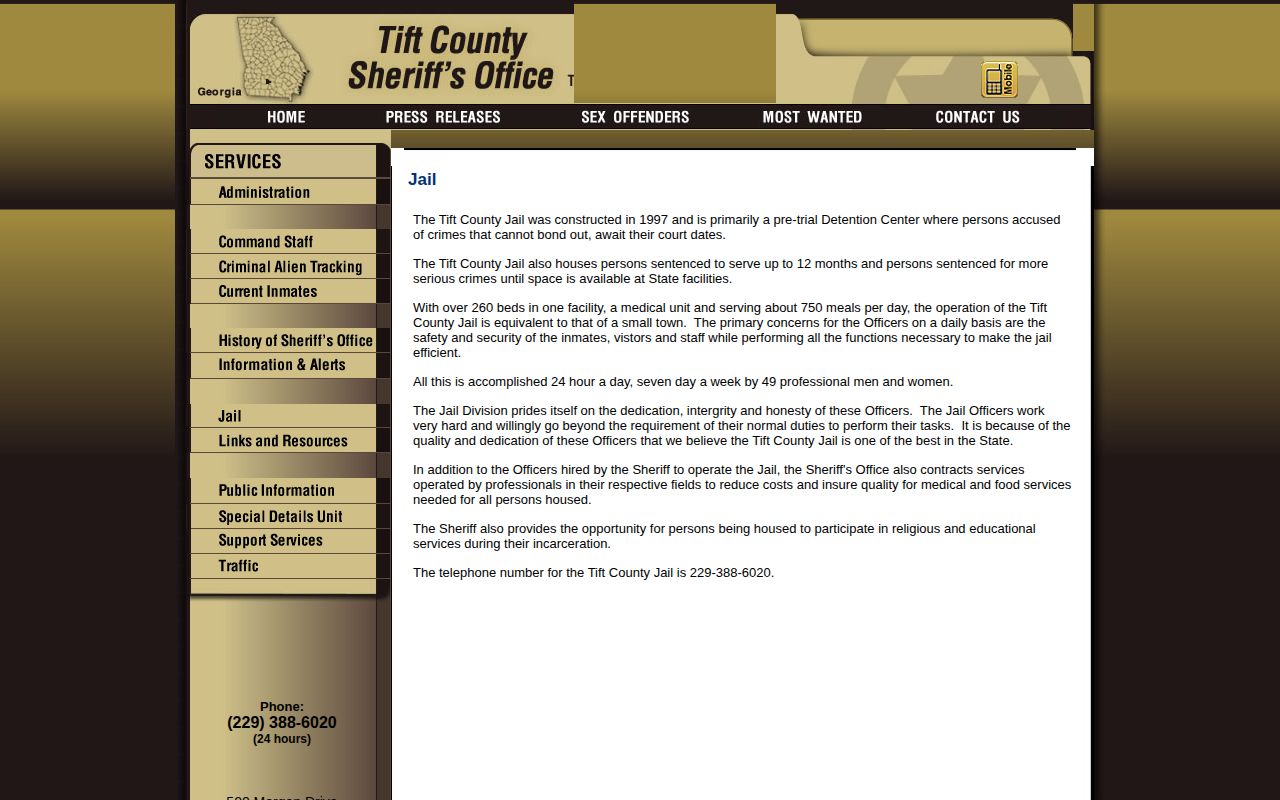
The source supports the facility history, role, and operational details used here.
Tift Jail Transfer Holds
The sheriff maintains a Criminal Alien Tracking page with annual and quarterly PDFs. Those documents do not prove that any named person has an immigration status or ICE hold. They do establish a local reason to distinguish release from transfer.
If the release record names ICE or another authority, search that agency after allowing for data transfer. ICE's Online Detainee Locator uses an A-Number and country of birth or biographical details. A federal detainee can also leave local custody under U.S. Marshals authority. In either case, the county record may show a transfer even though the person remains confined.
Tift Jail Release Paths
The facility's role determines the records that follow a departure. A pretrial detainee may leave after a court sets bond and the required bond is completed. A person serving a county sentence leaves when the sentence expires after any lawful earned-time allowance. Someone sentenced to state custody may remain at the Tift County Jail until GDC has space, then leave through a transfer rather than a local community release.
| Departure | Best confirming record |
|---|---|
| Bond release | Sheriff release record plus the court bond order |
| Local sentence completion | Jail record and sentencing order |
| Dismissal or court order | Court docket or signed order plus jail release time |
| GDC transfer | Sheriff destination field followed by GDC custody data |
| Other-agency hold | Sheriff transfer record and the receiving agency's locator |
O.C.G.A. 42-4-7 requires sheriffs to keep records of people committed to jail and addresses release of county-sentenced inmates at sentence expiration less earned-time allowances. It does not turn each departure into the same type of release. Bond, sentence, and transfer records must still be read separately.
Tift Courts Explain Jail Release
The jail confirms the physical event. The court explains the legal event. Tift County Magistrate Court handles arrest warrants, bond hearings, warrant hearings, pre-arraignments, and preliminary hearings. A record from that court may explain an early bond decision. State Court covers misdemeanors and certain traffic matters. Superior Court files contain felony proceedings and sentences. Tifton Municipal Court maintains city dockets and helps route city bond paperwork.
For Superior and State Court records, contact the clerk at 237 E. 2nd Street in Tifton or call 229-386-7810. Magistrate Court is at 225 Tift Avenue, Room 211, and uses 229-386-7907. Tifton Municipal Court operates from the Criminal Justice Center at 130 East 5th Street and uses 229-391-3967. Ask for the specific bond order, disposition, sentence, probation order, dismissal, or nolle prosequi entry that relates to the jail departure.
A court record can outlast the online jail view. That makes it especially useful after the sheriff's 48-hour page no longer shows the event. Still, the clerk may not have the exact moment jail staff completed release. Pair the legal order with the sheriff release record when both facts matter.
Tift Jail to GDC Transfer
The sheriff says Tift County Jail houses some people convicted of more serious crimes while they wait for room in a state facility. Their exit from Morgan Drive is not a discharge from the sentence. Once GDC accepts custody, use the Georgia Find an Offender page to locate the state record.
GDC searches can use a name, GDC ID, case number, and descriptive fields. A result may show the state facility, sentence details, maximum release date, a release date, and a photo when available. The system is not the right source for a person who simply posted bond in Tift County. If the transfer is recent and the state record has not appeared, confirm the destination with the jail before drawing a conclusion.
GDC's written verification route is Inmate Records and Information, P.O. Box 1529, Forsyth, Georgia 31029. A state maximum release date also differs from a county release time. It describes the state sentence framework, while the Tift County record describes the end of local custody.
Write a Tift Release Request
A focused request is easier for the sheriff to identify and price. Supply the full legal name, known booking date or date range, arresting agency, and a booking, case, or warrant number if available. Ask for named fields: booking sheet, date and time of release, stated release reason, bond amount, and transfer destination. If a booking photograph is requested, follow the separate compliance statement required by Georgia law.
The sheriff says requesters are responsible for fees associated with fulfillment and that an estimated preparation cost will be provided. Ask for that estimate before processing if cost matters. A request may be verbal or written, but a written request creates a clear list of the records sought. Protected information can be redacted, and some probation, parole, juvenile, medical, or active investigative material may not be released.
When the response says the person left on a court order, contact the correct clerk for the order. When it names another agency, use that agency's official locator or records office. This short handoff keeps the search tied to the authority that controlled each stage of custody.
Save the response with the date it was issued. The public roster can change after a release, while the supplied record preserves the agency's answer for the requested event. If a later court entry changes the case context, obtain that entry separately. The two records document different stages and should not be expected to use the same wording.
Use the same care with identity. A full name, booking date, and booking number are stronger than a name alone. If two records appear to match, ask the jail which identifier belongs to the requested event. That check is especially useful when the short release window has expired and the prior-inmate search returns more than one booking.